Termite Inspection Types Compared: Which One Do You Need?
Compare termite inspection options: DIY check, free company visit, home-sale report and annual inspection. See what each covers, its limits, and when to use it.
 Save
A termite inspection is a careful search of a building for live termites, damage and conditions that attract them, and it comes in several forms. For a quick look, a homeowner check works. For a home sale or a firm answer on active termites, a licensed professional’s written inspection is the better choice. The right one depends on why you are inspecting.
Key points
- Match the inspection to the reason. A routine check, a home purchase and a suspected infestation each call for a different level of detail.
- A self-check is a start, not a verdict. It can catch obvious mud tubes and wings, but it cannot see inside walls or under insulation.
- Free visits are often a sales step. A no-charge inspection can be useful, but read the proposal carefully and compare it with another opinion.
- Home-sale reports follow local rules. In the US, lenders may ask for a standard wood-destroying insect report. Canada, the UK and Australia have their own practices, so ask your agent or lender.
- A report covers one day. It records what was visible and accessible that day, and it is not a guarantee against future termites.
- Written findings matter. Ask for the areas checked, the evidence found, the areas that could not be reached and any recommended treatment.
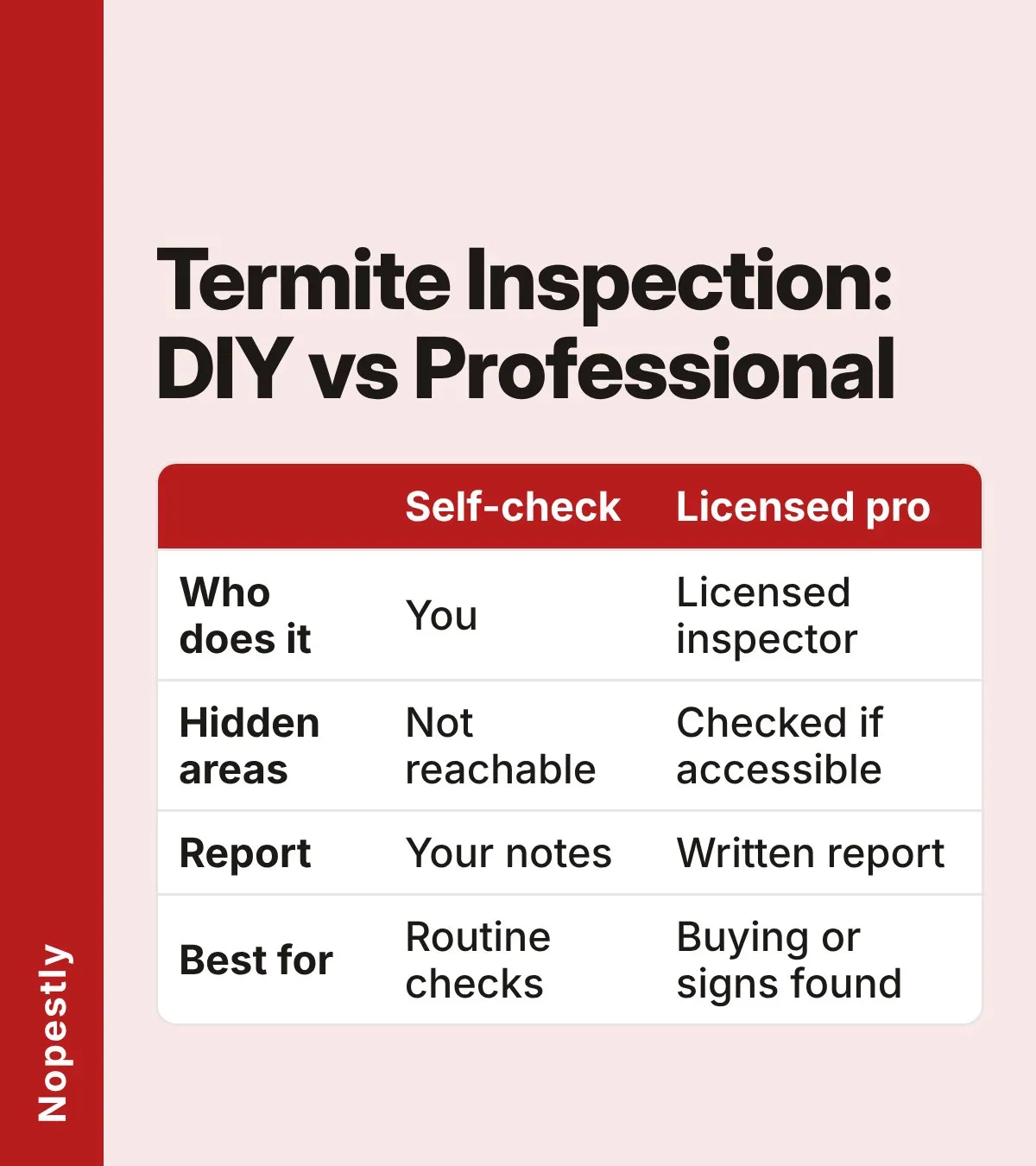
Quick answer: which termite inspection should you choose?
Use a homeowner self-check once or twice a year between professional visits. Book a licensed inspector when you buy or sell a home, when you find signs such as mud tubes or swarmers, or on a regular yearly schedule if you live in a termite-prone area. If a company offers a free inspection, accept it as a way to get a second pair of eyes, not as a neutral report.
The main inspection options compared
| Option | Who does it | What it covers | Main limit | Best for |
|---|---|---|---|---|
| Homeowner self-check | You | Foundation edge, visible mud tubes, wings, damaged wood, moisture | Cannot see inside walls, and you may miss subtle clues | Routine checks between visits |
| Free company inspection | Pest company staff | Visible evidence, conditions, a treatment proposal | May be linked to a sales quote | A first opinion, with a second to compare |
| Paid professional inspection | Licensed inspector | Accessible areas inside and out, with a written report | Hidden areas stay unchecked | Suspected activity or yearly checks |
| Home-sale wood-destroying insect report | Licensed inspector, often required by lender | Visible evidence of termites and other wood-destroying insects, plus damage | Snapshot in time, limited to accessible areas | Buying or selling a home |
| Annual inspection or monitoring plan | Pest company | Repeat visits, sometimes with stations or monitors | Ongoing fee, and the plan terms vary | Homes in high-risk areas or past infestations |
What a professional termite inspection checks
An inspector usually works from the outside in. Exact steps vary by company and region, but the usual areas are:
- Exterior. The foundation, siding, steps, porches, deck posts and anywhere wood touches soil. Mud tubes, soft wood and gaps around utility lines are typical findings.
- Crawl space or basement. Joists, sill plates, piers and the underside of the floor. Moisture and wood debris on the soil are checked here.
- Attic. Roof framing and areas near leaks or vents.
- Interior. Window and door frames, baseboards, flooring and wall surfaces. The inspector may tap wood and probe suspect spots with a tool.
- Conditions. Water leaks, poor drainage, firewood stacked against the house and soil sitting against siding.
For the evidence list an inspector looks for, see signs of termites in your house. If you are unsure whether the insects you saw are termites or ants, the carpenter ants vs termites guide shows the differences.
Step-by-step: get a useful termite inspection
| Step | What to do |
|---|---|
| 1 | Decide why you need it. Write down whether this is a routine check, a home purchase or a response to a sign you found. This tells the inspector what to focus on. |
| 2 | Choose a licensed professional. Rules differ by state, province and country, so check your local licensing authority and ask for proof of a license and insurance. |
| 3 | Prepare access. Clear a path to the crawl space, attic hatch, garage walls and foundation edge. Move stored items and firewood away from walls. |
| 4 | Share your history. Tell the inspector about leaks, past termite signs, earlier treatments and any warranty or bond on the home. |
| 5 | Walk along with the inspector. Ask to be shown any evidence, and take photos of what is found so you can compare opinions later. |
| 6 | Ask for a written report. It should list the areas inspected, evidence of live termites or damage, areas not accessible and any recommended treatment. |
| 7 | Get a second opinion on big jobs. If a costly treatment is advised, ask another licensed company to inspect before you sign. |
| 8 | Fix the conditions. Repair leaks, improve drainage and lift wood away from soil, since moisture and wood-to-ground contact help termites. |
Free inspection or paid inspection?
Both can be honest and useful. The difference is the relationship. A paid inspector is working for you, and in some places the inspection must be independent of any treatment sale, such as for a home sale. A free inspection is usually offered by a company that hopes to quote a treatment, so it may be less formal.
To get the most out of a free visit, ask these questions:
- Will I get a written report with photos?
- What evidence did you find, and where exactly?
- Which areas could you not reach?
- Is the treatment you propose for active termites, or only preventive?
If the answers are vague, treat the visit as a lead and get another opinion. Costs vary by region and home size, so look at local quotes rather than a national figure. For wider price context, the pest control cost guide explains what changes the price of a visit.
Buying a home: what to expect
In the US, lenders or sellers may require a wood-destroying insect report, and the inspection is usually arranged during the buying process. In other countries, a building inspector may include a timber pest check or a separate timber pest inspection may be recommended. Ask your agent or lender what is expected where you live.
Important points for buyers:
- The report describes the day of the inspection only.
- Areas covered by finished walls, stored items, insulation or soil may not be checked.
- If evidence of past treatment is found, ask for records and any warranty.
- Damage found may need a separate repair assessment by a builder.
Common mistakes
- Treating a self-check as an inspection. Hidden areas are the main place termites live.
- Skipping the crawl space. Many problems start low and out of sight.
- Not reading the limits. The “areas not inspected” section is as important as the findings.
- Signing a treatment on the spot. Take the written quote home and compare it.
- Forgetting moisture. Without repairs to leaks and drainage, conditions stay favorable.
When to call a professional
Call a licensed pest professional if you find mud tubes, swarmers, shed wings, hollow-sounding wood or small pellets, and before you buy a home. Extension specialists generally advise against DIY treatment of an active infestation, so use your own check to decide when to book, not to replace the inspector. Rules and licensing vary by state, province and country.
Sources
 Save
Frequently asked questions
How often should a house have a termite inspection?
Many pest professionals suggest a yearly inspection, and more often in high-pressure termite regions or if you have had termites before. Ask a licensed local company what schedule fits your area and your type of foundation.
Can a termite inspection find every termite?
No. Inspectors can only check areas they can see and reach, and termites feed hidden inside wood. A clean report means no evidence was found on that day, not a guarantee for the future.
Is a termite inspection the same as a termite treatment?
No. An inspection looks for evidence and gives a report. Treatment is a separate service, usually quoted afterward, so compare the report with at least one other opinion if a large job is recommended.
What should I do before the inspector arrives?
Clear a path to the crawl space, attic access, garage walls and the foundation edge. Move stored boxes and firewood away from walls, and note any damage or past treatments to tell the inspector.