
How to Get Rid of Mice in Your House
Learn the signs of mice, how to seal entry points, where to set traps, what to fix in your kitchen and garage, and how to clean up droppings safely.

The fastest way to get rid of mice is to do three things together: seal the gaps they use to get in, set plenty of snap traps where they travel, and remove the food and shelter that keep them around. Doing only one of these rarely works, because mice breed fast and new ones move in through any opening you missed.
Quick answer
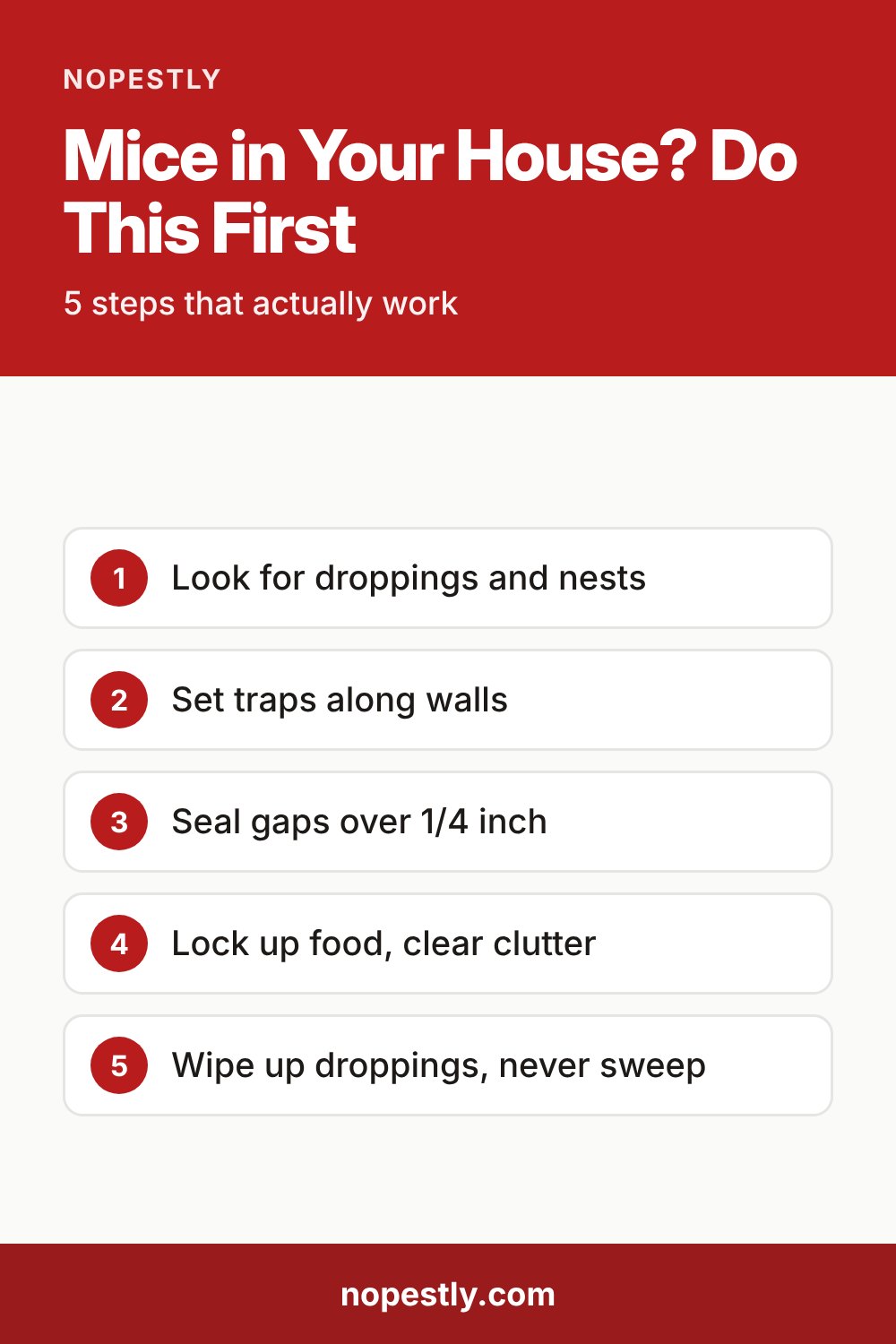
- Confirm you have mice by looking for droppings, gnaw marks, nests and noises.
- Set a generous number of traps along walls and near activity.
- Seal every gap larger than about a quarter inch (6 mm) with materials mice cannot chew through.
- Store food in tight containers and clear clutter.
- Clean up droppings and nesting material using wet methods and gloves, never a broom or vacuum.
Signs you have mice
Mice are secretive, so look for evidence rather than waiting to see one. Extension guidance from the University of Nebraska describes these common signs:
- Droppings: dark, pointed pellets about one-eighth to one-quarter inch long, scattered around rather than piled up. A mouse leaves a lot of them each day, so fresh droppings in a cupboard are a strong clue.
- Gnaw marks: fresh chewing looks pale and clean. Small, neat holes in cardboard or food packaging are typical.
- Nests: shredded paper, fabric or insulation tucked in a sheltered spot, often near something warm such as a water heater, oven or refrigerator.
- Sounds and smell: scratching or squeaking in walls or ceilings, and a musky odor where a problem has gone on for a while.
Check inside kitchen cabinets, behind appliances, in the pantry, along basement walls, in the garage and in the attic. Mice seldom travel far from their food and shelter, so start your search near warm spots and food storage.
What attracts mice and how they get in
A mouse needs only a small opening. According to the Nebraska extension guide, any hole about a quarter inch or bigger is worth sealing. Common entry points include:
| Where | What to look for |
|---|---|
| Around pipes and wires | Gaps where utilities enter the house, under sinks, behind the dryer |
| Foundation and siding | Cracks, missing mortar, gaps where materials meet |
| Doors, especially garage doors | Worn or missing door sweeps and gaps at the corners |
| Vents and chimneys | Torn screens and uncapped openings |
| Roofline and eaves | Gaps under shingles or soffit trim |
Once inside, mice stay for easy food (pet food, crumbs, open grain or cereal), clutter to hide in, and warmth.
What you need
- Snap traps (several dozen for an active problem, see below)
- A small amount of bait, such as peanut butter, or a cotton ball
- Gloves (rubber or plastic) and paper towels
- Household disinfectant, or household bleach for a fresh solution
- A flashlight
- Sealing materials: copper or stainless steel wire mesh, caulk or sealant, mortar or cement, metal flashing
Step-by-step: get rid of mice
1. Inspect and map activity
Use a flashlight to look for droppings, grease marks along walls, and chewed items. Make a note of each spot. Those are the places to put traps and the places to seal first.
2. Set traps in the right places
Snap traps are the most dependable DIY option when used correctly. Per the extension guidance:
- Place traps along walls, behind objects, in dark corners and wherever you find droppings.
- Space them no more than about 10 feet (3 m) apart in areas with activity.
- Use more traps than you think you need. The guide suggests around two dozen well-placed traps for a new infestation in a 1,500 square foot building.
- Where activity is heavy, set two traps side by side, at least an inch apart.
- Set the trigger so it is sensitive, and consider traps with an expanded trigger, which catch more mice.
- Try a small dab of peanut butter (skip it if anyone in the home has a nut allergy), a bit of chocolate or caramel, or a cotton ball for nesting-minded mice.
Check traps each morning, since mice are most active around dusk and dawn. Reset or replace traps until they stop catching anything.
3. Seal entry points
Trapping without sealing means more mice keep arriving. Use materials mice cannot chew:
- For small gaps around pipes, use sealant or mortar.
- For larger gaps, pack in copper woven mesh or stainless steel fiber, then finish with sealant or mortar.
- For bigger holes, use metal flashing, concrete or quarter-inch wire mesh.
- Skip soft materials. Rubber, plastic and thin boards do not stop mice.
Seal after the trapping has caught the mice inside, so none are shut in a wall.
4. Cut off food and shelter
Sanitation alone will not remove mice, but ignoring it undermines everything else.
- Store food, including pet food and birdseed, in tight-fitting containers.
- Wipe up crumbs and spills.
- Keep stored items and woodpiles at least 8 inches (20 cm) off the ground and about a foot from walls.
- Clear clutter in garages, basements and sheds so mice have fewer hiding places.
5. Clean up safely
Mouse droppings, urine and nests can carry germs, so the cleanup method matters. The CDC steps are:
- Open doors and windows and leave the area for about 30 minutes before you start.
- Put on rubber or plastic gloves.
- Do not sweep or vacuum droppings, urine or nesting material.
- Soak droppings and urine with a household disinfectant or a bleach solution made fresh each time (1.5 cups of household bleach per gallon of water, or 1 part bleach to 9 parts water). Let it soak at least 5 minutes, or longer if the product label says so.
- Wipe it up with paper towels and place them in a covered trash can.
- Mop or sponge hard surfaces with disinfectant.
- Wash your gloved hands before taking the gloves off, then wash your hands with soap and warm water.
Disinfect used traps and dead mice the same way. If you handle a dead mouse, wear gloves and bag it. If you feel unwell with a fever after cleaning up, mention the exposure to a health provider.
Trap and control options compared
| Method | Best for | Watch out for |
|---|---|---|
| Snap traps | Most homes, quick results | Fingers when setting; check daily |
| Bait stations with rodenticide | Professional-led programs | Risk to kids, pets and wildlife; follow the label as directed |
| Sealing and sanitation | Preventing a repeat | Does not remove mice already inside |
If you choose a rodenticide, use it only as the label directs and keep it where children and pets cannot reach it. Some stronger products are restricted to licensed applicants. Poisoned mice can die inside walls, where you cannot reach them, which can cause odor.
Common mistakes
- Too few traps. One or two traps will not keep up with a real problem.
- Traps in the open. Mice run along walls, so traps in the middle of a room get ignored.
- Skipping the sealing step. Without it, new mice replace the ones you catch.
- Using soft fillers. Mice chew through foam, rubber and plastic.
- Sweeping droppings. This puts particles in the air and is not recommended by the CDC.
- Leaving pet food out overnight. It is a reliable food source.
When to call a professional
Bring in a licensed pest professional if you still see signs after a couple of weeks of consistent trapping, if mice are in walls or ceilings you cannot reach, if there are droppings across many rooms, or if you are not comfortable using rodenticides safely. A professional can also find entry points that are hard to see, such as the roofline.
Sources
Frequently asked questions
How long does it take to get rid of mice?
A small, new problem can be cleared in a week or two with enough traps and sealed gaps. Mice breed quickly, so a longer-running infestation can take more time, and it will return if the entry points stay open.
Where should I put mouse traps?
Set them along walls, behind objects, in dark corners and wherever you find droppings. Mice rarely wander far from shelter and food, so place traps close to where you see signs of activity.
Can I just use poison?
Poison baits can be hazardous to children, pets and wildlife, and you cannot control where a poisoned mouse dies. If you use any rodenticide, follow the product label exactly, or ask a licensed pest professional.
Is it safe to sweep up mouse droppings?
No. Sweeping or vacuuming can put dust from droppings into the air. Wet them with disinfectant, wipe them up with paper towels and throw the towels in a covered trash can.